Hello, I'm Ömer.
I start with real needs, bringing design, software, and AI agents together to turn ideas into working products and repeatable production workflows.
About Me
I'm a product developer with a background in architecture. I start by understanding the problem and the user's needs, then work across design, APIs, databases, interfaces, and deployment to build an end-to-end solution.
My approach is close to that of a Forward Deployed Engineer: I bring user communication, product decisions, and technical implementation together. I orchestrate AI agents for research, development, and automated testing while taking responsibility for quality, security, and the real user experience.
I learn by trying new models and methods in my own projects.
Projects & Explorations
Products, prototypes and the technical questions I explore along the way. Each project comes with its focus areas and notes from the process.
Timeline19 projects
From the first projects to today. Scroll across to explore.

Fer Mimarlık
Architecture & interiors
Active
Tiyasis
Marketplace analytics
Active
Fumels
E-commerce
Active
MomAlly
AI emotional support
Prototype
Dumpl
iOS product
Development
Trendyol Product Research
Large-scale product data infrastructure
Paused
Trendyol Sales Estimation Model
Trained machine learning model
Research
3D Asset Platform
Shipped digital product
Active
Toptan Kolye
Wholesale jewelry commerce
Active
Line Tales
Personalized story-map studio
Prototype
Agent Memory System
Developer memory system
Internal tool
GlassNav
Navigation HUD prototype
Prototype
ContentCreator
AI-assisted video production
Internal tool
Social Publishing Automation
Publishing workflow research
Internal tool
Architecture Production Workflow
Spatial capture to project model
Internal tool
DAVRC Studio
Visualization research system
Internal tool
DPP Atlas
Digital Product Passport directory
Development
Realtime Conversational Avatars
Realtime avatar research
Prototype
Tiyasis · ChatGPT Plugin
Conversational product integration
Prototype
An architecture practice delivering interior projects from client brief and site constraints through coordinated models, drawings and visual presentations.
Technical focus
Notes from the process
What I explored
Selected work spans residential renovation, bespoke interiors and commercial spaces, with decisions checked against the existing building and client feedback.
What I took away
- I keep concept dimensions separate from verified manufacturing dimensions until the appliance and site conditions are confirmed.
- I treat a render as a spatial communication tool, not proof that represented lighting or construction details have been built.
About the date: Practice date supplied in the existing portfolio record.
A SaaS platform for Turkish marketplace sellers, with Trendyol profitability reports, campaign tools, and store analytics.
Technical focus
Notes from the process
What I explored
I shaped reporting and analysis workflows that turn order and product data into clear profit insights while separating measured values from estimates.
What I took away
- I label commission as either a value supplied by Trendyol or a calculated estimate so sellers can see where each number comes from.
- For anonymous product research, I combined usage quotas with progressive cooldowns and learned to balance abuse controls with the experience of real users.
About the date: The start month is the date previously used in the portfolio; accessible Git history begins later.
3D Asset Platform
Shipped digital product
A shipped 3D asset platform managing 200,000+ assets and storage, sharing, and access security for 100 TB+ of data, with payments, subscriptions, and ongoing marketing.
Technical focus
Notes from the process
What I explored
I turned a large asset catalog into a usable product through search, taxonomy, and private project boards. I brought storage and secure file delivery together with payments, subscription entitlements, account management, and marketing workflows. I developed hybrid retrieval that combines embedding-based semantic search with keyword results.
What I took away
- Managing hundreds of thousands of assets taught me to separate catalog data from file access while coordinating search, storage, and permissions.
- Connecting payments, subscriptions, and download entitlements required designing the product across payment events, account state, and file delivery.
About the date: The earliest accessible repository record is a documentation foundation dated August 27, 2026; it is not the exact project start date.
A home-living store presenting candle and candlestick collections through product stories, usage ideas, and image-led product pages.
Technical focus
Notes from the process
What I explored
I worked on an e-commerce experience connecting a Turkish product catalog with an editorial storefront, product details, and store administration.
What I took away
- I paired catalog data with usage scenarios and editorial cards; keeping product details consistent across the storefront made content design easier.
- I used Polaris for store administration and a separate design language for the storefront; designing each surface around its users made the experience clearer.
About the date: The start month is the date previously used in the portfolio; accessible Git history begins later.
Dumpl
iOS product
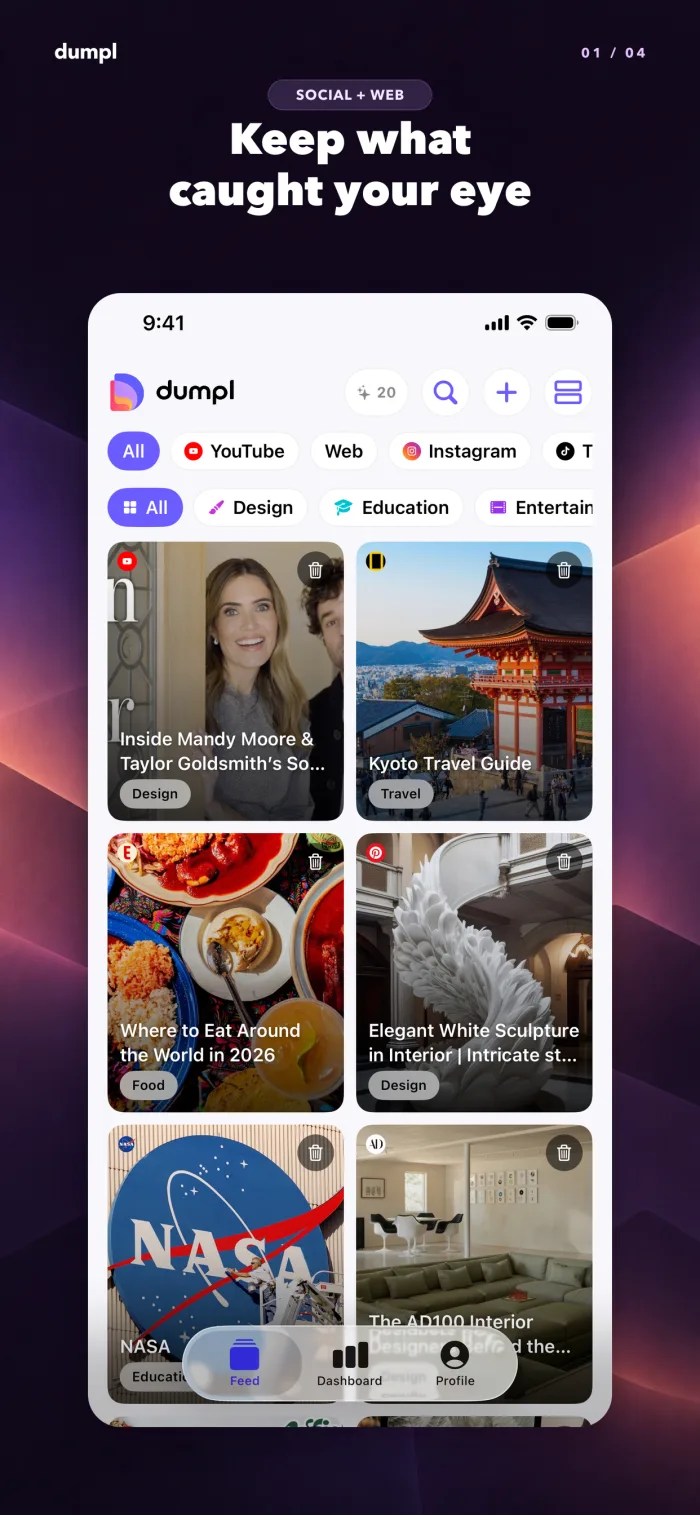
An iOS app extracting content data and link previews across Instagram, TikTok, YouTube, X, and other social platforms into one personal archive.
Technical focus
Notes from the process
What I explored
I developed ingestion flows that parse different page structures and metadata formats into a shared content model, working across platform-specific extraction rules, content previews, and local archive search.
What I took away
- Different metadata and page structures across social platforms led me to build platform-specific parsers behind a shared normalization layer.
- Caching content snapshots and cancelling outdated work taught me how much feed responsiveness depends on the data lifecycle.
About the date: Existing portfolio month retained; the earliest Git record is 22 June 2026 and is not treated as the product's founding date.
An e-commerce application for the Turkish market, with a fixed-price wholesale jewelry catalog, cart, and order flows.
Technical focus
Notes from the process
What I explored
I developed a store foundation that handles guest and member orders, inventory, and payment events within one commerce flow.
What I took away
- I kept order creation and payment confirmation inside short database transactions so inventory and order state stay consistent together.
- I routed store notifications through an event queue; retries and Telegram's limited delivery acknowledgement made separate notification tracking necessary.
About the date: The start month is the date previously used in the portfolio; accessible Git history begins in October 2026.
DPP Atlas
Digital Product Passport directory
A directory for exploring Digital Product Passport solutions, standards, regulatory sources, and sector use cases with source evidence.
Technical focus
Notes from the process
What I explored
I shaped the first directory pilot across DPP sectors around source observations, editorial review, approved content releases, and a controlled publishing flow.
What I took away
- I did not infer a provider's capabilities from its category label; linking each field to a source and observation date kept uncertainty visible.
- I did not turn research directly into publication; editorial approval and fixed content releases made the directory's scope and claims reviewable.
About the date: The earliest accessible repository record is an infrastructure scaffold dated October 5, 2026; the decision to make DPP the first niche was recorded on October 6.
MomAlly
AI emotional support
An AI companion exploring long-term chat and diary memory, multidimensional emotion tracking, and personalized periodic summaries.
Technical focus
Notes from the process
What I explored
I explored how session and diary memories can support continuity without treating memory as model training. The implementation stores chat exchanges and diary entries, adds a weekly digest, and retrieves memories alongside entries for generated summaries. Emotion is represented as multiple scores; mood is a derived label, rather than a replacement for those scores.
What I took away
- I learned to preserve separate emotion dimensions instead of reducing a person's experience to one positive-or-negative label.
- I used retrieval and periodic digests to give summaries continuity, while keeping stored memories distinct from the language model itself.
About the date: Earliest verified repository record: the initial MomAlly monorepo commit on 14 February 2026.
Line Tales
Personalized story-map studio
A generative-image studio turning personal stories into illustrated maps through structured story drafts and a consistent visual style.
Technical focus
Notes from the process
What I explored
I connected schema-constrained story normalization with multi-reference image-to-image generation. I managed style references separately from story-specific visual context and brought editable intermediate output, asynchronous generation jobs, and result archiving into one studio.
What I took away
- I found that separating the fixed style reference from story-specific references makes each image input's role easier to control.
- I made the normalized story editable before image generation so I could correct narrative structure without spending image-generation credits.
About the date: Earliest verified project record: the work log dated 13 August 2026.
GlassNav
Navigation HUD prototype
A SwiftUI navigation prototype that presents Google Maps guidance in a mirrored windshield heads-up display.
Technical focus
Notes from the process
What I explored
I routed location, route, and maneuver updates through a shared navigation state into a mirrored HUD. Separating the provider adapter from presentation supported orientation changes, route simulation, and display switching while guidance remained active.
What I took away
- Separating navigation state from its presentation let me switch to the mirrored HUD while preserving the active route.
- I validate mirrored HUD layout and guidance behavior on a physical phone as well as in simulator runs.
About the date: The earliest reviewed project records are dated 30 September 2026; the app is a prototype and has not been released on the App Store.
Realtime Conversational Avatars
Realtime avatar research
Experiments connecting a speech-to-speech model with realtime portrait animation, exploring low-latency dialogue, interruption, and natural speaking and listening behavior.
Technical focus
Notes from the process
What I explored
I brought speech-to-speech inference, audio-driven facial animation, and asynchronous frame delivery into one conversation pipeline. I worked on VAD, conversational turn-taking, barge-in, and cancellation of stale audio and frame queues, evaluating stream stability separately from lip sync and portrait quality.
What I took away
- I learned to test interruption and resume behavior for stale audio or frames, instead of judging realtime performance only by response latency.
- I treat stream stability and portrait quality as separate engineering questions; a working pipeline does not solve facial identity, mouth shape, or listening behavior.
About the date: Earliest verified workspace record is dated 13 October 2026; the actual experiment start is unknown.
ContentCreator
AI-assisted video production
A short-form video toolkit combining generative models, real product captures, and editable Remotion compositions in a repeatable production workflow.
Technical focus
Notes from the process
What I explored
I built around model operation and content production: ComfyUI workflows generate clips, while Remotion assembles selected material into reviewable videos. I kept production quality separate from technical checks such as resolution, audio transcription, and codec metadata; a successful render alone does not establish visual approval.
What I took away
- I learned to preserve the prompt, seed, source clip, and editable composition so I can trace and revise a result instead of treating it as a one-off generation.
- I review rendered frames and spoken content separately from metadata, because technical validity does not establish natural-looking or publishable quality.
About the date: Earliest verified local project record: 22 September 2026; the available materials do not establish the actual start date.
Architecture Production Workflow
Spatial capture to project model
An internal workflow for turning site capture, measured constraints and client references into coordinated architectural models, drawings and quantity takeoffs.
Technical focus
Notes from the process
What I explored
LiDAR review, Blender mesh inspection, CAD or SketchUp modeling and preliminary takeoffs connect existing conditions to design decisions and presentation views.
What I took away
- I inspect scan geometry against known dimensions before using it to place design elements or estimate quantities.
- I label suggested model dimensions as preliminary and keep them out of fabrication decisions until the source and site are confirmed.
About the date: Dated modeling records exist by 12 September; the earliest reviewed LiDAR and takeoff handoff is 15 September 2026. These are record dates, not a workflow founding date.
Trendyol Product Research
Large-scale product data infrastructure
A product research system built to actively track and update more than 2 million Trendyol products, covering continuous collection, stock and ranking signals, and resilient operation.
Technical focus
Notes from the process
What I explored
I developed a pipeline to collect changing product information, manage recurring updates, and serve research views at million-product scale. I balanced work queues, bounded retries, collection throughput, and data freshness. The service was paused in October 2026.
What I took away
- At million-product scale, data collection became more than a one-off scrape: scheduling, retries, and resumable work were essential to keeping the system operating.
- I kept stock, seller, and ranking changes as separate signals and learned that obtaining fresh data and drawing reliable sales conclusions are different problems.
About the date: Accessible engineering records begin on July 13, 2026; the service was paused in October 2026 and its analysis infrastructure was removed on October 8.
Trendyol Sales Estimation Model
Trained machine learning model
A machine learning model I trained to estimate past sales from Trendyol product information and observed signals, exploring feature engineering, gradient boosting, and calibrated prediction confidence.
Technical focus
Notes from the process
What I explored
I engineered product and category features and modeled sales probability and volume in separate stages. Quantile regression captured sales ranges and calibration addressed confidence. Product-group splits kept the same product from leaking across training and validation. Predictions concern past 3-, 7-, and 30-day windows.
What I took away
- Results from overlapping product records did not establish generalization; I used product-level holdouts and feature ablations to test assumptions.
- Alongside point estimates, I modeled when confidence was insufficient, using quantile regression and confidence calibration to identify uncertain predictions.
About the date: The earliest accessible model-repository record is dated July 13, 2026; it marks the repository record rather than the exact project start.
DAVRC Studio
Visualization research system
A source-backed discovery and research workflow for finding architecture and interior practices that may need outsourced visualization and rendering.
Technical focus
Notes from the process
What I explored
Campaign discovery feeds bounded website research and evidence-linked company records; contact enrichment is gated and email sending is not implemented.
What I took away
- I position visualization as helping design teams communicate their decisions, rather than making those decisions for them.
- I preserve the source behind each research claim and do not infer missing people or contact details from a company's website.
About the date: Earliest repository record is the 28 September 2026 baseline commit; that is the first recorded implementation, not the idea's origin.
Tiyasis · ChatGPT Plugin
Conversational product integration
A ChatGPT plugin bringing Tiyasis calculations and store analytics into a conversation, with interactive product and report cards.
Technical focus
Notes from the process
What I explored
I connected Tiyasis calculation engines to a conversational interface with distinct access boundaries for free tools and account-linked Premium data. I developed MCP tool calls, OAuth, and interactive cards together; the integration remains in private testing.
What I took away
- I connected the integration to Tiyasis' existing calculation engine instead of rewriting it, then added parity checks to keep results consistent across both interfaces.
- I presented product photos and results in cards within ChatGPT; keeping the test deployment private separated product feedback from a public release decision.
About the date: The private test integration and product-card work were recorded in October 2026; the card experience was verified on October 16 and was not publicly released.
Agent Memory System
Developer memory system
A Codex-native, Markdown-first second brain that captures project context, compiles durable notes and retrieves them across work sessions.
Technical focus
Notes from the process
What I explored
Adapted from the Avenox Beyin approach, the system queues lifecycle events, summarizes conversations in the background, and retrieves project context for later sessions. I separated daily records, session summaries, and durable knowledge, using rebuildable full-text indexes over canonical Markdown sources.
What I took away
- I keep Markdown as the canonical record and treat search indexes as disposable, rebuildable views of that record.
- I make lifecycle hooks leave short, durable queue signals and move slower summarization into a background worker.
About the date: First implementation record: the repository commit dated 26 August 2026.
Next Shiny Object™
Currently chasing the next bright idea
We don't know what it is yet. But it will definitely begin as ‘just a small side project.’
Work Areas
Areas of Interest
Currently
- Developing profitability analytics in Tiyasis and exploring conversational calculations and reports through a ChatGPT plugin prototype.
- Preparing DPP Atlas for launch with source verification and an editorial review workflow.
- Experimenting with speech-to-speech, interruption, and natural speaking and listening behavior in conversational avatars.
- Building persistent memory and context management for AI agents, alongside repeatable image, video, and social publishing workflows.
- Working on cross-platform content extraction and the personal archive experience in Dumpl.
- Connecting LiDAR, 3D modeling, and quantity takeoffs in my architecture practice while running my e-commerce products.
Social Publishing Automation
Publishing workflow research
A browser-based publishing workflow with platform-specific steps, media checks, duplicate prevention, and human review before publication.
Technical focus
Notes from the process
What I explored
I explored repeatable preflight and platform-specific browser steps with a fail-closed checkpoint. Each post is tied to an exact video and destination; verified outcomes are reconciled to an append-only history. A later Pinterest publisher applies the same idea to fixed, reviewed batches.
What I took away
About the date: The local browser runner was recorded after four successful manual publications on 24 September 2026; an automation campaign was recorded the following day.